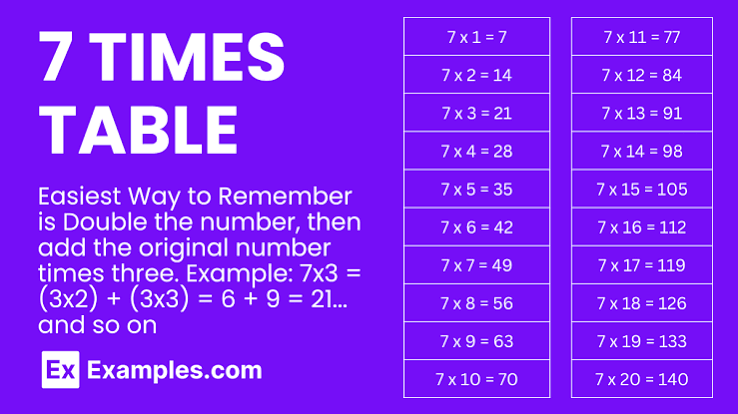

Mathematical patterns provide a straightforward way to understand how numbers relate to one another. One example is the sequence of multiples of seven, which can be calculated through multiplication, repeated addition, and division. This method is useful for learning basic arithmetic, organizing numerical data, and examining patterns without requiring advanced mathematical knowledge.
Understanding the Multiplication Rule
A multiple of seven is a number obtained by multiplying seven by a whole number. The basic formula is:
M = 7 × n
In this formula, M represents the resulting number, while n represents a whole number. If n equals four, the result is 28. If n equals nine, the result is 63. Increasing n by one adds seven to the previous result, producing a consistent numerical sequence.
The sequence begins with 7, 14, 21, 28, 35, 42, 49, 56, 63, and 70. Each number follows the same rule, making the sequence easy to extend. Beginners can calculate additional values by multiplying seven by successive integers or by repeatedly adding seven to the previous result.
Both approaches produce identical results. Comparing them provides a simple way to check arithmetic accuracy and understand the relationship between multiplication and addition.
Identifying Patterns in the Sequence
Multiples of seven have several properties that can be observed by examining their digits. For example, the final digits of consecutive multiples follow a repeating cycle: 7, 4, 1, 8, 5, 2, 9, 6, 3, and 0. After ten steps, the same cycle begins again.
This repetition occurs because each new value increases by seven while the final digit depends on the remainder after division by ten. Understanding this relationship introduces the basic concept of modular arithmetic, which examines remainders rather than entire numbers.
Another useful observation concerns the difference between consecutive values. Subtracting one multiple from the next always produces seven. For instance, 56 minus 49 equals seven, while 70 minus 63 also equals seven. These consistent differences confirm that the sequence follows a fixed arithmetic rule.
Applying the Method to Four-Digit Numbers
Four-digit numbers can be examined through place value, multiplication, and divisibility. In Togel 4D, numbers are commonly represented using four digits, but their mathematical properties can be studied independently of any particular activity.
Consider the number 2,814. It contains two thousands, eight hundreds, one ten, and four units. Its expanded form is 2,000 + 800 + 10 + 4, which equals 2,814.
To determine whether this number is a multiple of seven, divide it by seven. The result is 402, with no remainder. Therefore, 2,814 is divisible by seven because seven multiplied by 402 equals 2,814.
By comparison, 2,815 divided by seven produces a remainder of one. This distinction demonstrates why division provides a reliable test for divisibility. The presence of a particular digit or a visually interesting arrangement does not, by itself, establish that a number belongs to the sequence.
Organizing Numerical Calculations
A numerical worksheet can make the process easier to follow. Create columns for the number, its corresponding multiplication formula, the division result, and the remainder. Recording these details helps maintain consistency and makes errors easier to identify.
For example, a worksheet might include 49 as 7 × 7, 84 as 7 × 12, and 126 as 7 × 18. Each entry can be checked by dividing the result by seven. If the remainder is zero, the number is a multiple of seven.
A calculator can verify the calculations, although performing several examples manually helps strengthen arithmetic skills. Keeping the original values and formulas together also makes it easier to compare results without relying on memory.
Understanding the Limits of Number Patterns
Numerical patterns describe relationships within a defined mathematical system. They can establish whether a value is divisible by seven, identify repeated final digits, or reveal the constant difference between consecutive multiples.
However, these properties cannot automatically predict unrelated outcomes. When a process uses independent random selections, a number’s relationship to seven does not establish that it is more likely to appear in the next result.
Information published by sources such as Alexistogel should therefore be evaluated by distinguishing verifiable mathematical calculations from claims about future numerical outcomes. A formula can demonstrate a specific arithmetic relationship, but it cannot guarantee a prediction merely because a pattern exists.
The most accurate approach is to define the calculation, apply the appropriate formula, and verify the result through multiplication or division. This process keeps numerical analysis grounded in established mathematical principles and makes each observation easier to explain and reproduce.