
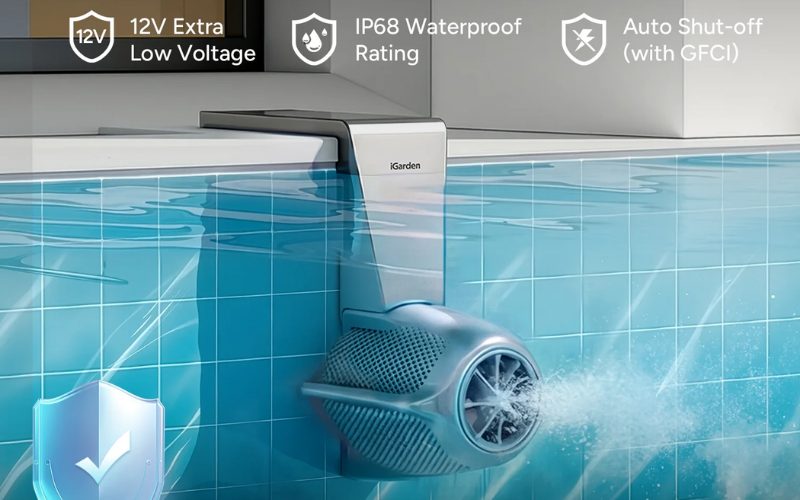
A swim current can make a home pool much more useful for exercise. However, training performance is not the only thing that matters.
- Water Sound and Motor Noise Are Different
- Do Not Judge Noise From Motor Power Alone
- Vibration Can Travel Through the Pool Structure
- Portable and Fixed Systems Feel Different
- Higher Current Settings Can Change Poolside Sound
- Smooth Flow Can Improve Comfort
- Consider P200 for Regular Home Training
- Think About the People Outside the Pool
- Placement Can Reduce Unwanted Disturbance
- Comfort Matters More Over Time
Noise, vibration, and poolside comfort also affect the experience.
A powerful current may feel great in the water. But a loud motor or noticeable vibration can become distracting during longer sessions. It can also affect people relaxing near the pool.
These issues are easy to overlook when comparing flow rates and maximum speeds.
For a home pool, it is worth thinking about how the system feels both in and out of the water.
Water Sound and Motor Noise Are Different
Every swim current creates some sound.
Moving hundreds of gallons of water produces splashing and surface movement. This is normal.
Mechanical noise is different.
It comes from the motor, moving parts, mounting points, or supporting equipment.
A good system should keep mechanical sound from dominating the natural sound of the water.
This becomes more important during long workouts.
A short ten-minute session may make noise easy to ignore. A forty-minute endurance swim is different.
Pool location matters too.
If the pool sits close to a patio, bedroom, or neighboring property, sound deserves more attention.
Do Not Judge Noise From Motor Power Alone
A larger motor does not automatically mean a louder system.
Motor design, speed control, mounting, and housing all affect sound.
A powerful system can still be designed for smooth operation.
At the same time, even a smaller motor can become annoying if vibration transfers into a hard surface.
This is why simple power figures do not tell the whole story.
If a manufacturer provides a measured sound rating, it can be useful for comparison. If no decibel figure is available, look at motor design and installation method instead.
User videos can also help you understand the general character of the sound.
Vibration Can Travel Through the Pool Structure
Sometimes the motor itself is not the main problem.
Vibration can travel through the mounting point.
A rigid connection to a deck or pool structure may transfer movement into surrounding materials. Hard surfaces can then make the vibration easier to notice.
Loose mounting can create another problem.
If brackets or fasteners are not secure, small movements may create rattling or repeated contact sounds.
Correct installation matters.
The unit should remain stable while operating. It should not shift every time the current changes speed.
If unusual vibration appears after installation, check the mounting before assuming that the motor is the cause.
Portable and Fixed Systems Feel Different
Portable and fixed systems can create different poolside experiences.
A portable unit can be removed when it is not needed. This is useful when you want the pool area to feel open during parties or casual swimming.
It also gives you more freedom to test placement.
If one location creates unwanted vibration or water noise, another position may work better.
A fixed system offers different advantages.
It remains ready for regular workouts. There is no need to move equipment before every session.
Correct mounting becomes more important because the installation is intended to stay in place.
Neither approach is automatically quieter.
The quality of the motor, mounting system, water flow, and installation all matter.
Higher Current Settings Can Change Poolside Sound
The same system may sound different at different settings.
At low resistance, water movement is gentle.
At high resistance, much more water may reach the surface. This can increase splashing and water noise.
That does not always mean the motor has become dramatically louder.
Sometimes the extra sound comes mainly from the current itself.
Think about how you normally train.
If most workouts use moderate resistance, maximum-setting sound may not matter very much.
Advanced swimmers who frequently use high output should pay more attention to the experience at stronger settings.
Smooth Flow Can Improve Comfort
Poolside comfort is also connected to flow quality.
A turbulent current can create more surface disturbance.
Water may splash against walls or return toward the swimming zone in unpredictable ways.
A wider, controlled current can feel more stable.
This benefits the swimmer, but it can also reduce unnecessary chaos around the training area.
When comparing a swim jet system, it is useful to look beyond maximum flow. Consider the shape of the current, the motor design, installation style, and how the system will fit into the pool environment.
These details can matter as much as raw performance during everyday use.
Consider P200 for Regular Home Training
For a dedicated home training pool, the iGarden P200 is one model worth considering.
It offers up to 900 GPM of flow and is aimed at regular fitness swimming. The P Series also uses a stainless-steel motor that the manufacturer describes as ultra-quiet.
This makes the P200 a reasonable middle choice for someone who wants strong training performance without automatically moving to the highest-output model.
The wider fan-shaped current can also be useful during longer sessions.
For advanced swimmers who need more resistance, the P230 increases maximum flow to 1,100 GPM.
However, extra output should be chosen because you need it for training. It is not always necessary for a comfortable home workout.
Think About the People Outside the Pool
A swim jet may be used by one person, but the pool area is often shared.
Someone may be reading nearby.
Family members may be talking on the patio.
Neighbors may be close to the property line.
This makes poolside sound an important part of the buying decision.
Consider when you normally swim.
Early-morning and evening workouts make quiet operation more valuable.
A loud system may be less of an issue in the middle of the day at a large property.
The same equipment can therefore feel very different in two homes.
Placement Can Reduce Unwanted Disturbance
Where possible, avoid placing mechanical equipment directly beside the main seating area.
Also think about nearby walls.
Hard walls can reflect sound back toward the pool deck.
An open location may feel quieter even when the equipment itself produces the same amount of sound.
For portable systems, experiment before settling on a regular position.
For fixed systems, plan placement carefully before installation.
A small change in location can sometimes improve both current quality and poolside comfort.
Comfort Matters More Over Time
Maximum current speed is easy to compare.
Comfort is harder to put on a specification sheet.
Yet comfort often becomes more important after several months of use.
A system that feels smooth, stable, and unobtrusive is easier to include in a daily routine.
Look at motor quality, mounting, water movement, and installation together.
Do not assume the highest-output system is automatically the best option.
The ideal setup provides enough resistance for your training while keeping unnecessary vibration and mechanical noise under control.
That balance makes the pool better not only for the swimmer, but also for everyone spending time around it.